
Teza Treated Timbers is a Manufacturer establishment in Kwambonambi, KwaZulu-Natal, South Africa
Teza Treated Timbers: Supplier of Treated Timber in Kwambonambi, KwaZulu-Natal
Teza Treated Timbers has been supplying quality treated timber since 1997, operating from a location in the timber heartlands of KwaZulu-Natal. The business emphasises its regional focus, with proximity to rail, the N2 highway, and Richards Bay harbour, which supports both local supply and export activity to neighbouring countries.
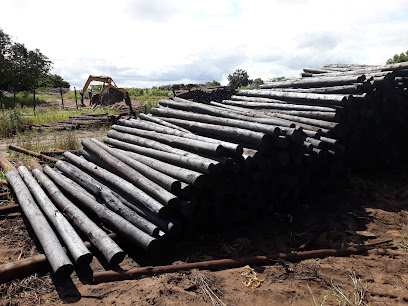
As a manufacturer and supplier, Teza Treated Timbers centres its offering on treated timber products that are prepared to established industry standards. The company is a member of SAWPA and conducts external quality control for poles through SABS assessment. Poles are pressure treated to SABS 457 and SANS 1288 specifications, with treatment levels indicated as H3 and H4, reflecting suitability for different outdoor and structural environments. This framework suggests a focus on durability and reliability in structural timber applications.
Main products and services
- Cresote (creosote) treated timber products, including:
- Utility poles
- Building poles
- Fencing poles
- Guardrails
- Spacer blocks
- Chromated Copper Arsenate (CCA) treated timber, with plans to offer CCA in full production by the end of 2024.
The Cresote line is described as a heavy-duty preservative option that is oil-based and water-resistant, commonly identifiable by the characteristic dark colour left on the wood. The CCA option, once fully introduced, would provide an alternative preservative for customers seeking the greenish tint associated with CCA-treated timber.
Typical job types and industries
The product range supports sectors that rely on durable outdoor and structural timber. Typical applications align with utility poles, building poles, fencing solutions, guardrails, and related infrastructure components. While specific project types are not exhaustively listed, the focus on poles and structural timbers indicates suitability for rural and civil infrastructure, fencing and perimeter projects, and construction involves in or near transport corridors and harbours.
How requests and orders are typically handled
Teza Treated Timbers concentrates on serving the local KwaZulu-Natal area, with export capability to neighbouring countries. The company maintains its operations from an accessible site adjacent to major transport routes, which supports local customers in need of timely delivery and reliable supply. The emphasis on SABS and SANS specifications, plus external quality control, suggests a procedural approach to order handling that prioritises specification compliance and quality assurance.
Practical tips for customers
- Identify the required preservative type (cresote or CCA) and the desired treatment level (H3 or H4) to ensure suitability for the intended environment and load conditions.
- Verify the specific pole or timber dimensions and lengths needed for the project, and confirm availability for fast-moving or urgent orders given the regional focus.
- Be aware of regional logistics when planning deliveries, noting that the operation is well-placed near rail, the N2, and Richards Bay harbour for potential freight options.
- Consult with qualified assessors or engineers if atmospheric exposure or load bearing is critical, especially for large infrastructure projects using treated poles and timbers.
- Check timelines for any updates on CCA production, as this could influence material choice and lead times.
Hours and location
Business hours are from Monday to Friday, 7:00 am to 4:30 pm. The operation is located in Kwambonambi, KwaZulu-Natal, with the site described as adjacent to railway infrastructure and the N2, in close proximity to Richards Bay harbour. The regional focus indicates service to KwaZulu-Natal communities and nearby regions, with the potential for cross-border exports.
Kwambonambi
KwaZulu-Natal
South Africa
Sorry, no records were found. Please adjust your search criteria and try again.
Sorry, unable to load the Maps API.
Manufacturer services in Kwambonambi, KwaZulu-Natal
In Kwambonambi, KwaZulu-Natal, manufacturer services encompass a broad range of capability across sectors such as engineering, fabrication, and lightweight assembly. Local facilities typically provide both bespoke and small-to-medium scale production, serving industries ranging from construction and infrastructure to consumer goods and agricultural equipment. The landscape combines traditional workshops with modern machining practices, enabling on-site production, finishing, and testing within reasonable lead times for regional clients.
Clients can expect a practical blend of services designed to translate a design concept into a tangible product. Core offerings often include machining and fabrication, where components are cut, shaped, welded, bolted, or joined by suitable methods. Precision work may cover milling, turning, drilling, and allied processes intended to achieve specified tolerances for mechanical parts or assemblies. Where appropriate, metal and plastic parts are finished to meet functional and aesthetic requirements, with attention to durability in local climates and operational conditions.
Prototyping and small-batch production are common features, allowing customers to test ideas before committing to full-scale manufacture. This supports iterative development and rapid problem-solving, particularly useful for product refinement, custom equipment, or replacement parts. In addition, many manufacturers in the area offer assembly services, bringing together components from multiple suppliers into a completed unit ready for installation or shipment.
Quality control is an important consideration for customers seeking reliability and consistency. While specific certifications may vary, standard practice often includes inspection and testing of critical dimensions, material verification, and process documentation. Facilities typically maintain a clean, organised workspace to support efficient production flows and minimise delays. Adherence to safety and environmental guidelines is a notable feature of reputable operations, reflecting the practical needs of local compliance and worker welfare.
Logistics and delivery are integral to the service model. Local manufacturers commonly arrange convenient collection or delivery within KwaZulu-Natal and neighbouring provinces, subject to capacity and distance. Some operations also offer storage and kitting, enabling customers to streamline procurement by receiving components in staged consignments aligned with project milestones.
For customers engaging with manufacturer services in Kwambonambi, practical considerations include evaluating capacity relative to project scale, lead times, and the ability to adapt to evolving requirements. Clear communication about material choices, surface finishes, and assembly procedures helps ensure that final products meet functional needs and longevity expectations in South Africa’s varied climates. Given the regional export routes and domestic demand, flexibility around scheduling and recurring orders is frequently advantageous.
When planning a project, potential clients are advised to discuss the intended use of the manufactured item, required tolerances, testing needs, and post-production support. While some facilities specialise in particular material families—such as metalworking, plastics, or composites—many offer a broad service mix to accommodate diverse client needs. The outcome is typically a made-to-order component or assembly delivered ready for installation or further integration into a broader system.
Overall, manufacturer services in Kwambonambi balance practical, hands-on production with established quality practices and responsive service. The resulting offerings aim to provide dependable, locally produced parts and assemblies that support regional industries, sustain maintenance cycles, and enable efficient project execution across KwaZulu-Natal.
- Machining: turning, milling, drilling
- Fabrication and welding
- Prototyping and small-batch production
- Parts assembly and sub-assembly work
- Surface finishing and post-processing
- Quality control and inspection practices
- Logistics, delivery, and storage options